
Pyramids
The Great Pyramid of Giza (called the Pyramid of Khufu and the Pyramid of Cheops) is the oldest and largest of the three pyramids in the Giza Necropolis bordering what is now El Giza, Egypt. It is the oldest of the Seven Wonders of the Ancient World, and the only one to remain largely intact. Egyptologists believe that the pyramid was built as a tomb forfourth dynasty Egyptian Pharaoh Khufu (Cheops in Greek) over an approximately 20 year period concluding around 2560 BC. Initially at 146.5 metres (480.6 ft), the Great Pyramid was the tallest man-made structure in the world for over 3,800 years. Originally, the Great Pyramid was covered by casing stones that formed a smooth outer surface; what is seen today is the underlying core structure. Some of the casing stones that once covered the structure can still be seen around the base. There have been varying scientific and alternative theories about the Great Pyramid's construction techniques. Most accepted construction hypotheses are based on the idea that it was built by moving huge stones from a quarry and dragging and lifting them into place.
There are three known chambers inside the Great Pyramid. The lowest chamber is cut into the bedrock upon which the pyramid was built and was unfinished. The so-called Queen's Chamber and King's Chamber are higher up within the pyramid structure. The Great Pyramid of Giza is the only pyramid in Egypt known to contain both ascending and descending passages. The main part of the Giza complex is a setting of buildings that included two mortuary temples in honor of Khufu (one close to the pyramid and one near the Nile), three smaller pyramids for Khufu's wives, an even smaller "satellite" pyramid, a raised causeway connecting the two temples, and small mastaba tombs surrounding the pyramid for nobles.
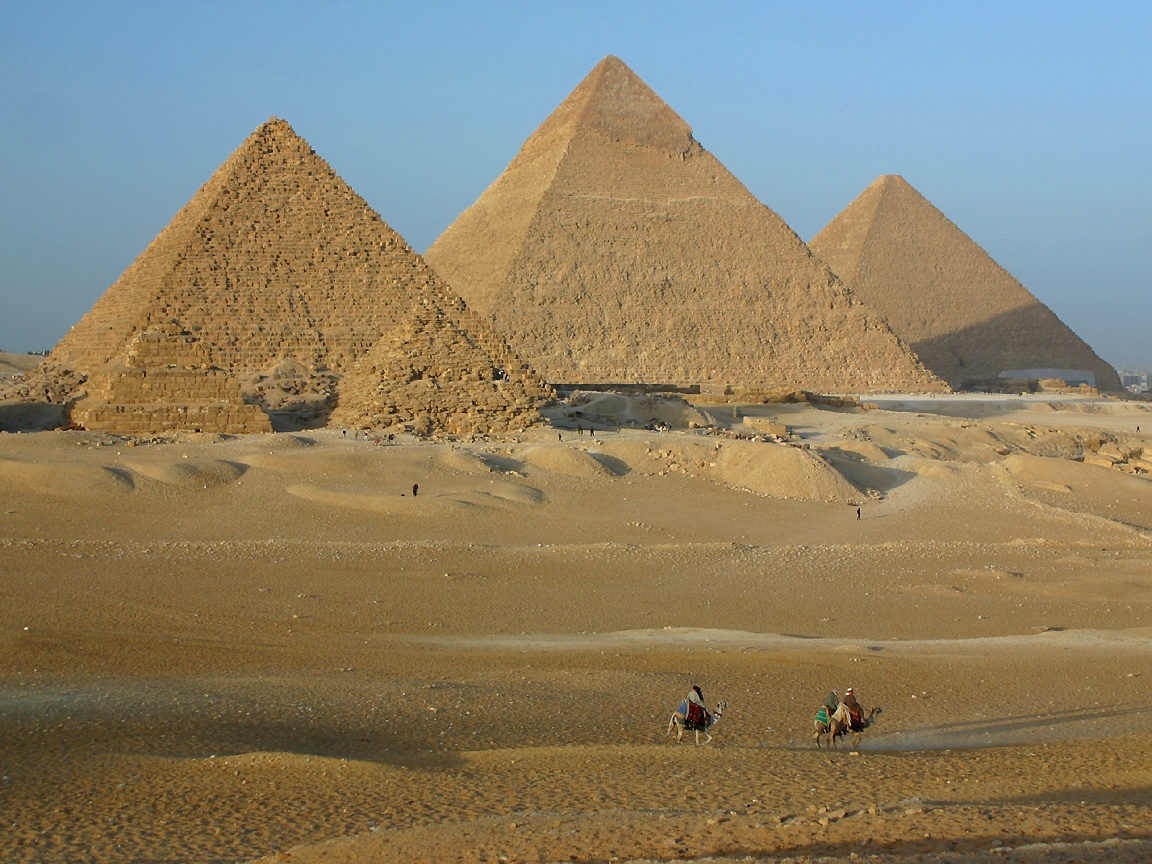
The pyramid remained the tallest man-made structure in the world for over 3,800 years, unsurpassed until the 160-metre-tall spire of Lincoln Cathedral was completed c. 1300. The accuracy of the pyramid's workmanship is such that the four sides of the base have an average error of only 58 millimetres in length. The base is horizontal and flat to within ±15 mm.The sides of the square base are closely aligned to the four cardinal compass points (within 4 minutes of arc) based on true north, not magnetic north, and the finished base was squared to a mean corner error of only 12 seconds of arc. The completed design dimensions, as suggested by Petrie's survey and subsequent studies, are estimated to have originally been 280 cubits high by 440 cubits long at each of the four sides of its base. The ratio of the perimeter to height of 1760/280 cubits equates to 2π to an accuracy of better than 0.05% (corresponding to the well-known approximation of π as 22/7). Some Egyptologists consider this to have been the result of deliberate design proportion. Verner wrote, "We can conclude that although the ancient Egyptians could not precisely define the value of π, in practice they used it". Petrie, author of Pyramids and Temples of Gizeh concluded: "but these relations of areas and of circular ratio are so systematic that we should grant that they were in the builder's design".Others have argued that the Ancient Egyptians had no concept of pi and would not have thought to encode it in their monuments. They believe that the observed pyramid slope may be based on a simple sekedslope choice alone, with no regard to the overall size and proportions of the finished building.
Materials
The Great Pyramid consists of an estimated 2.3 million limestone blocks with most believed to have been transported from nearby quarries. The Tura limestone used for the casing was quarried across the river. The largest granite stones in the pyramid, found in the "King's" chamber, weigh 25 to 80 tonnes and were transported from Aswan, more than 500 miles away. Traditionally, ancient Egyptians cut stone blocks by hammering wooden wedges into the stone which were then soaked with water. As the water was absorbed, the wedges expanded, causing the rock to crack. Once they were cut, they were carried by boat either up or down the Nile River to the pyramid. It is estimated that 5.5 million tons of limestone, 8,000 tons of granite (imported from Aswan), and 500,000 tons of mortar were used in the construction of the Great Pyramid.